
How to discover music for DJ sets and develop your own sound
Finding more tracks is easy; finding the right tracks takes a method. Build a discovery routine that connects your taste to music you can confidently play.
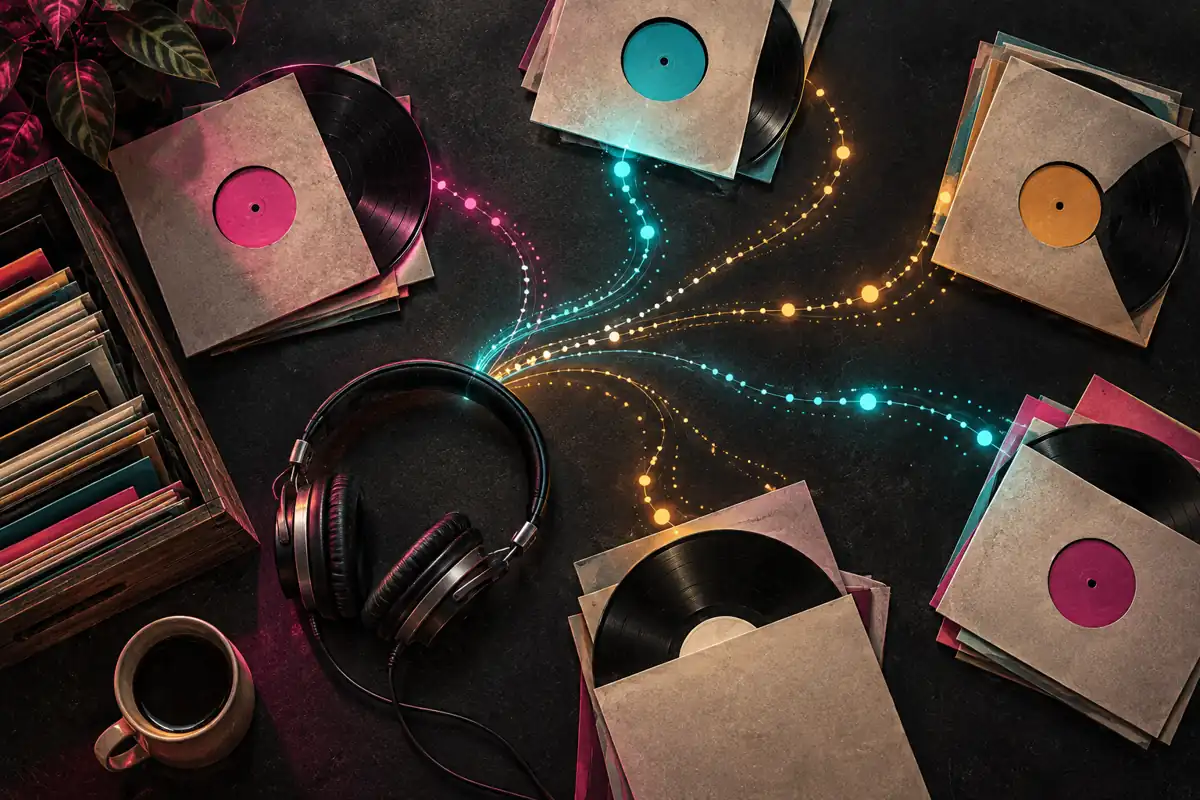
To discover useful music for DJ sets, follow connections between tracks, artists and labels, then filter what you find through your own listening. Separate discovery from purchasing and preparation. A small collection of music you understand is more valuable in the booth than an enormous folder of unfamiliar files. Your sound emerges from repeated choices, not from finding one secret website.
Where should I begin when I want fresh music for my sets?
Choose three reference tracks that represent different things you enjoy. One might have the drum movement you want, another a particular bass texture and another a vocal atmosphere. Write down what attracts you to each. These descriptions become search directions that are more precise than simply looking for good music or the newest release in a very broad genre.
Open the official artist and label pages associated with those tracks. Look at the surrounding catalogue, the other artists on the release and any named remixers. Follow one connection at a time. If you jump across ten unrelated recommendations immediately, it becomes difficult to remember why a particular track mattered or where you first found it.
Keep the original link with your notes. A title alone can be ambiguous, especially when several remixes or edits exist. Record the artist, release and version where possible. This also helps you find an authorised purchase later instead of spending another evening trying to reconstruct a discovery from a vague filename.
Why are record labels useful for discovering related music?
A label can offer an editorial thread across different artists. That thread may involve a rhythmic approach, a production aesthetic or a particular scene. Listen to several releases before deciding what the connection is. Labels change over time, and a catalogue can contain surprising exceptions. Treat the label as a useful path through music rather than a guarantee that every release will fit.
Explore older releases as well as the latest page. A track does not become unsuitable for a new set because it was released years ago. Back catalogues can reveal music that feels fresh in a different context, especially when paired with newer selections. The relevant question is whether it contributes something to your programme, not whether its release date looks current.
Compilations are particularly useful for widening the search. If several contributors interest you, visit their individual catalogues and compare what they make outside that collection. You can develop several distinct listening paths from one release without losing the musical connection that brought you there.
How can radio shows, mixes and tracklists help me find tracks?
A good mix lets you hear music in context. Notice the selections that change your attention and write down the approximate time. Look for an official tracklist or a description supplied by the DJ, broadcaster or label. Where the information is incomplete, keep the timestamp and source link rather than guessing and later treating the guess as a confirmed identification.
Listen to what happens around the track you like. Perhaps its impact comes from a sparse selection before it, a change of rhythm or a long period without vocals. Discovering the title is only part of the lesson. Understanding its role helps you decide whether it will work in your own collection and what preparation it might need.
Avoid copying an entire running order just because the recording works. Use the mix to discover artists and techniques, then make your own selections. A performance that fits one DJ, room and moment may not suit yours. Developing taste includes understanding why you would leave out an impressive track as well as why you would keep one.
How should I use recommendations without getting trapped in the same sound?
Recommendation systems can make a search convenient, but the results depend on their inputs and the service's design. Balance familiar suggestions with deliberate exploration. Try an artist's earlier work, a label outside your usual country, a different tempo range or a compilation curated by someone whose judgement you respect. You do not need to keep everything for the exploration to be worthwhile.
Set a boundary for the session. Decide that you will explore one label, one radio episode or a small group of artists, then stop and review. An unlimited stream of previews can make every track blur into the next. Focused listening gives individual ideas a better chance to remain in your memory.
Keep a separate place for discoveries that interest you but do not fit an immediate performance. This prevents your main set folder from becoming a miscellaneous collection while still leaving room for your taste to evolve. A tune that has no role tonight may become the starting point for a different kind of set later.
How do I decide whether a track is worth adding to my DJ library?
Listen to more than the most dramatic section. Check the introduction, a developed passage, the main transition and the ending. Notice whether the arrangement gives you usable entry and exit points, whether a vocal requires space and whether the production remains convincing at a normal listening level. A short preview can attract you, but it may not answer all of these questions.
Ask what the track adds that your collection currently lacks. Does it provide a bridge between two styles, a calmer moment, a distinctive rhythm or a strong closing idea? This is not a rule against buying similar music. It is a way to make intentional choices rather than repeatedly collecting slight variations of a tune you already own.
Revisit the track after a break when possible. Immediate excitement and lasting usefulness are not always the same. If you still remember the groove or can imagine a specific pairing, that is useful information. If you cannot explain why it belongs in your library, leave it in the discovery list until the reason becomes clearer.
What is a practical weekly routine for finding DJ music?
Divide the work into three sessions. Use the first for discovery and save links without interrupting every listen to organise files. Use the second for focused evaluation and authorised purchases or downloads. Use the third for technical preparation, including metadata, grids, cue points and a short mixing test. The separation reduces the temptation to confuse collecting with being ready to perform.
Choose a session length that fits your schedule. Consistency matters more than an ambitious target you cannot maintain. Some weeks may produce only a few useful tracks, and that is fine. A small number of well-understood additions can change your options more than a large batch imported without listening.
Before a gig, work from music you have already evaluated. Leave a small space for genuinely useful late discoveries, but do not rebuild the whole library the night before. Familiarity reduces the attention you need to spend on the screen and leaves more room for the audience, timing and musical decisions.
How should I organise discoveries so that I can find them later?
Use a simple progression: discovered, shortlisted, acquired, prepared and tested. These can be folders, playlists or tags in whichever tools you already use. The important point is that a track's status is clear. A link you saved while travelling should not look identical to a local file you have rehearsed and backed up.
Add a few searchable notes describing sound and role. Rolling, broken rhythm, spacious, vocal-led and short ending may be more useful than a complicated rating system. Keep technical information such as BPM and key separate from subjective impressions. Automated analysis can supply a starting point, but it does not decide whether the music suits a particular room.
Preserve the artist and release information. Do not replace meaningful titles with private shorthand that makes future identification difficult. If multilingual titles display incorrectly, address the display or metadata issue carefully and keep a backup. Organising your collection should make music easier to find without erasing its identity.
How do I turn a promising discovery into a track I can perform with?
Acquire it from an authorised source and confirm that the actual file matches the version you wanted. Listen for unexpected edits, damaged audio or a different mix. Import it into your DJ software, check its analysis and prepare only the landmarks you need. A download confirmation does not tell you whether the first downbeat or a tempo change was analysed correctly.
Try the track beside two or three selections you already know. Test both an entrance and an exit. Pay attention to vocals, bass overlap and the time available to introduce the next record. If a blend fails, distinguish between a poor pairing and a preparation problem. Moving a cue point cannot make every arrangement compatible.
Keep the original file and a backup of your library data. After preparation, avoid renaming or relocating music casually, because the software may lose the connection to it. Use the library's supported relocation tools when changes are necessary. A discovery becomes genuinely useful when you can retrieve and play it reliably.
How can I develop a recognisable sound without repeating myself?
Look for a consistent point of view rather than an identical recipe. You might repeatedly favour restless drums, spacious bass, unusual vocal textures or a particular balance of tension and release. Those preferences can connect music from different years and styles. A recognisable sound does not require every track to share the same BPM or producer.
Review your own recorded sets and track histories. Which selections still interest you after the event? Which moments felt borrowed rather than personal? Use those observations to guide the next discovery session. The goal is not to invent a brand description before you have listened; it is to recognise the choices that keep proving meaningful in practice.
Leave room for change. Follow new connections, revisit forgotten music and be willing to retire tracks that no longer serve your sets. A strong library is a living collection shaped by listening. Your most useful discovery habit is the ability to hear something clearly, explain why it matters and decide when it belongs in front of an audience.
Questions and answers
Where should I start looking for new music for my DJ sets?
Start with a few tracks you genuinely enjoy. Follow their artists, labels, remixers and credited collaborators, then explore related releases. This gives your search a musical direction instead of relying entirely on broad charts.
How can I find underground tracks that everyone else is not playing?
Explore label back catalogues, compilation contributors, radio tracklists and artists' own recommendations. Spend time listening beyond the leading release. There is no guaranteed source of exclusive discoveries; your selection and context create the distinction.
Can I use a song from a streaming playlist in my DJ software?
A saved streaming song is not automatically a downloadable audio file or a licence for every DJ use. Check the service's supported integrations and terms, or find an authorised download from the artist, label or store.
How do I stop collecting tracks that I never play?
Keep discoveries in an inbox, revisit them later and promote only tracks with a clear musical role into your performance collection. Separate listening favourites from music you have tested for a set.
Should I follow charts or trust my own taste?
Use charts as one discovery source, then judge the music yourself. Listen to the arrangement, sound and intended context. Popularity can tell you what is circulating, but it does not tell you whether a track fits your set.
How often should I look for new DJ music?
A regular, manageable routine works better than an exhausting search before each gig. Separate discovery, focused listening and technical preparation so that new tracks do not reach the booth before you know them.
Comments, questions & ideas
Have a question or something to add? Join the conversation.